It is 7:15 in the morning in a busy preoperative area. The first case of the day is a hip replacement, and the surgeon is already scrubbing. An older patient with a painful joint sits on the edge of the stretcher for a spinal block, lightly sedated and asked to curl forward. An anesthesia tech stands in front, arms wrapped around the patient’s shoulders, carrying most of the upper body weight. The patient sways and begins to slump. The anesthesiologist pauses. The tech’s back and shoulders absorb every second of the delay, and the OR schedule starts to slip.
Spinal block positioning is a high risk patient handling task. When a caregiver serves as the positioning device, patient safety, staff safety, and surgical efficiency all suffer together. Safe Patient Handling and Mobility (SPHM) research identifies the operating room as a setting where lifting and holding patients is a recognized high risk task. The same research confirms that engineering controls are the preferred solution because they create permanent change that eliminates risk at the source.
This article explains why spinal block positioning is so demanding, why manual holding fails as an injury prevention strategy, and how the SPH Medical Epidural Positioning Device (EPD) protects patients, anesthesia teams, and your facility’s bottom line.
Why Spinal Block Positioning Is Clinically and Ergonomically Demanding
A spinal block depends on a stable, flexed posture that opens the spaces between the lumbar vertebrae. The surgical patient population makes that posture uniquely difficult to reach and hold.
The patient must flex forward and round the lower back so the anesthesiologist can identify landmarks and reach the subarachnoid space accurately with a fine needle. In the OR, several factors work against that goal. Preoperative sedation reduces postural control. Orthopedic pain limits movement. Older patients often have reduced flexibility and balance. Meanwhile, the caregiver must hold a partially sedated patient upright, often leaning over a stretcher at a fixed height, for the full length of the procedure.
Several conditions make OR spinal blocks harder:
- Sedated patients who slump or drift without warning
- Painful joints and limited mobility in orthopedic patients
- Older patients with reduced balance and flexibility
- Schedule pressure that leaves no room for repeat attempts
Consider a lightly sedated knee replacement patient who loses posture midway through needle placement. The anesthesiologist stops while the tech struggles to pull the patient back upright. In the OR, positioning is not a preliminary step. It directly determines spinal block success, staff safety, and whether the first case starts on time.
Why Manual Holding Is Not an Engineering Control
Manual holding is not an engineering control. It is a work practice that places the hazard squarely on the caregiver, and decades of SPHM evidence confirm that work practices alone do not prevent injury.
The Hierarchy of Controls
Engineering controls change the equipment or environment to remove the hazard. Behavioral and administrative controls rely on people performing perfectly every time. Engineering controls are preferred because they are permanent and consistent. Asking an anesthesia tech to hold a sedated patient does not remove the hazard. It simply transfers the load onto the tech’s spine.
The Evidence Is Clear
Supporting a sedated patient requires sustained static holding, forward reaching, and a flexed spine, the exact awkward postures research links to musculoskeletal injury.
The numbers are sobering:
- Hospital workers sustained 46,000 work related back injuries in 2001
- Roughly 38 percent of those injuries were tied directly to patient handling
- Back injuries account for 33 percent of workers’ compensation costs and 27 percent of lost workdays
- The cumulative weight a nurse handles in one typical shift equals roughly 1.8 tons
OHSU Biodynamics laboratory testing confirms that manual patient handling generates far higher physical loads than assistive devices. And thirty five years of research show that body mechanics classes and lifting technique training consistently fail to reduce caregiver injuries. Better technique cannot make manual holding safe.
Here is how the two approaches compare:
- Manual holding: depends on staff strength and stamina, varies by caregiver, loads the spine and shoulders, weakens as fatigue sets in, and cannot compensate for sudden slumping
- Engineered positioning with the EPD: consistent for every patient, independent of who is in the room, removes the load from staff, and holds steady for the full procedure
Picture an anesthesia tech who supports four spinal blocks before noon on an orthopedic block day. Each one adds static load to a back that will still be lifting and positioning patients all afternoon. The evidence based answer is to replace the caregiver’s body with equipment engineered for the task.
How the SPH Medical EPD Stabilizes the Patient and Removes Caregiver Strain
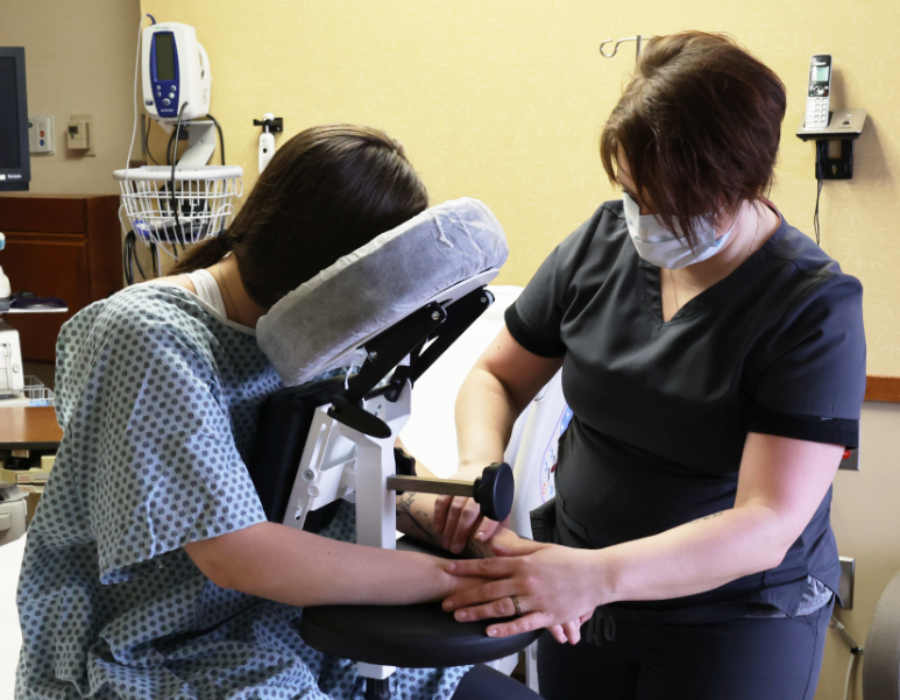
The SPH Medical Epidural Positioning Device, also known as the Epidural Chair, supports patients securely in the optimal flexed posture. It stabilizes the patient, optimizes access for the anesthesiologist, and removes the physical load from staff.
- A stable patient: A secure, supportive surface gives sedated and unsteady patients something solid to rest against, limiting slumping and sudden movement.
- Optimized access: Consistent spinal flexion presents a reliable target for needle placement.
- Reduced caregiver strain: The device provides upper body support, so staff stop bracing and holding and start monitoring.
- Standardized setup: Every patient is positioned the same way in every preoperative bay, regardless of staff height, strength, or experience.
What Changes in the Preoperative Area
- The patient leans forward onto a stable support instead of a caregiver’s arms
- The anesthesia tech shifts from holding to observing and reassuring
- The anesthesiologist meets a predictable, steady posture every time
- Positioning becomes a written protocol step rather than an improvised effort
Patient handling equipment is among the SPHM interventions with the strongest evidence for reducing caregiver injury. When a surgical services department adds the EPD to its spinal block protocol, every bay follows the same standardized setup, and new staff learn the engineered method from day one.
Benefits for Anesthesiologists and Anesthesia Techs
A stable, consistently positioned patient gives anesthesiologists reliable access and stronger success rates, while anesthesia techs are freed from the most physically punishing part of their day.
- Reliable access: Steady flexion keeps the target consistent from landmark identification through injection.
- First attempt success: A stable posture supports first attempt placement and fewer needle redirections.
- Consistent setup: Standardization delivers the same high level of care regardless of individual experience.
- No pausing to reposition: The team stays focused on the procedure, not on pulling a slumping patient upright.
- Reduced physical demand: Static holds disappear, lowering strain on the back, shoulders, and arms.
Imagine an anesthesiologist covering multiple orthopedic rooms who finds the same stable, well supported patient in every bay. When the equipment holds the position, the anesthesia team can focus entirely on precision and patient care.
Patient Comfort and Satisfaction
Patients who feel securely supported stay calmer and steadier, which makes needle placement safer and the entire surgical experience less intimidating.
Holding a flexed position while sedated, in pain, and facing surgery is physically and emotionally difficult. Being held by a caregiver can feel unstable. The EPD provides a sense of security and dignity, and testimonials and reported outcomes show improved patient comfort and satisfaction with the device.
Patients benefit from:
- Greater comfort and stability during placement
- Reduced anxiety before surgery
- Lower risk of positioning related complications
- Higher patient satisfaction scores
A supported patient is a steady patient, and a steady patient is a safer one.
Facility ROI: Workers’ Compensation Savings and Surgical Throughput
The EPD delivers returns on two critical fronts at once: fewer costly staff injuries and a faster, more predictable surgical schedule.
- Workers’ compensation savings: The average cost of a single back injury was $13,445. Removing manual holding reduces strain injuries and the claims that follow.
- Fewer lost workdays: Roughly 12 percent of nursing personnel consider leaving their jobs each year because of injury. Protecting anesthesia techs and perioperative nurses preserves hard to replace specialized staff.
- Faster throughput: Consistent positioning shortens block time in busy preoperative areas.
- On time first case starts: Predictable setup reduces delays that ripple through the entire OR schedule.
- Accreditation support: A visible commitment to standardized safety supports facility ratings and potential accreditation.
Picture a value analysis committee comparing the cost of the EPD against one year of strain related claims, lost workdays, and delayed first cases. The EPD is not an accessory. It is a high return investment in staff safety, OR efficiency, and performance improvement goals.
No Caregiver Should Hold a Patient’s Weight for a Block to Succeed
Spinal blocks demand stable positioning. Sedated and orthopedic surgical patients make that posture hard to hold, and manual holding is not an engineering control. The SPH Medical EPD stabilizes the patient, optimizes access, removes caregiver strain, and keeps busy preoperative areas moving, all in alignment with AORN and ANA SPHM standards.
Start by observing spinal block positioning in your preoperative areas. Identify where staff are manually holding patients, then bring your findings to your SPHM or value analysis committee.
Contact SPH Medical today for more information or to schedule a demonstration of the EPD.
Coming next in Article 3 of this series: how the EPD replaces the unstable overbed table and pillow setup for thoracentesis in imaging departments.
Frequently Asked Questions
- Why is positioning so important for a spinal block?
Lumbar flexion opens the spaces between the vertebrae, giving the anesthesiologist a clear path to the subarachnoid space. A stable posture keeps landmarks consistent throughout the procedure. That stability supports accurate, first attempt needle placement and fewer redirections. - What makes manual holding during spinal blocks a staff safety risk?
Holding a sedated patient requires sustained static effort, forward reaching, and a flexed spine, postures linked to musculoskeletal injury. Anesthesia techs often repeat this task several times a day, compounding the load. Decades of research show training alone does not prevent these injuries. - How does the EPD work as an engineering control in the OR?
The EPD removes the hazard at its source by replacing manual holding with standardized, purpose built support. This follows the SPHM hierarchy of controls, where engineering solutions are preferred over work practices, and aligns with AORN SPHM standards. - Can the EPD improve preoperative efficiency?
Yes. Consistent setup shortens block time, reduces repeat attempts, and eliminates pauses to reposition slumping patients. Together, these gains support on time first case starts and a more predictable OR schedule.