A dependent patient needs to move from bed to chair. Two nurses position themselves, bend at the waist, brace, and lift on a count of three. It works, this time. But the cumulative weight a single nurse lifts across one shift adds up to roughly 1.8 tons, and every manual lift loads a spine the human body was never engineered to protect against that kind of strain.
Mechanical lift equipment is the proven answer, and a strong safe patient handling program relies on two complementary tools working together: mobile lifts and overhead lifts. Patient handling equipment is one of the few interventions with strong evidence for reducing caregiver injury, and both the ANA and AORN call for eliminating manual lifting wherever feasible. Here is what you will take away from this article:
• The scale of the injury problem manual lifting creates
• How mobile floor lifts work and which tasks they address
• How overhead ceiling lifts excel at high frequency tasks
• How the two lift types complement each other for complete coverage
Grounded in evidence based Safe Patient Handling and Mobility practice, this discussion starts with the problem both lift types are designed to solve.
The Injury Problem Manual Lifting Creates
Manual patient lifting is among the leading causes of disabling injury in nursing, and decades of evidence confirm that no amount of body mechanics training changes that reality.
The numbers tell a sobering story. Hospital workers sustained 46,000 work related back injuries in 2001, and roughly 38 percent of those injuries were tied directly to patient handling. Back injuries account for 22 percent of all injuries and illnesses, 27 percent of lost workdays, and 33 percent of workers compensation costs. The human toll is just as steep. Roughly 12 percent of nursing personnel consider leaving the profession each year because of injury, with back pain a primary driver.
Picture a charge nurse on a short staffed shift who authorizes a quick manual transfer to keep things moving. What that nurse cannot see is the load traveling through each caregiver’s spine, a load that exceeds safe thresholds and compounds with every repetition.
Manual lifting puts a great deal at risk:
• Strains, sprains, and career ending back injuries
• Lost workdays and rising workers compensation claims
• Experienced staff who leave the profession after injury
• Patient safety during unstable, uncoordinated lifts
OHSU Biodynamics laboratory testing confirms that manual handling generates spinal loads far exceeding those seen with assistive devices, and the ANA Handle with Care campaign supports eliminating manual lifting altogether. The evidence is settled. Manual lifting is the hazard, and mechanical lift equipment is the intervention with the strongest support. The first pillar of that intervention is the mobile floor lift.
How Mobile Floor Lifts Work and What They Address
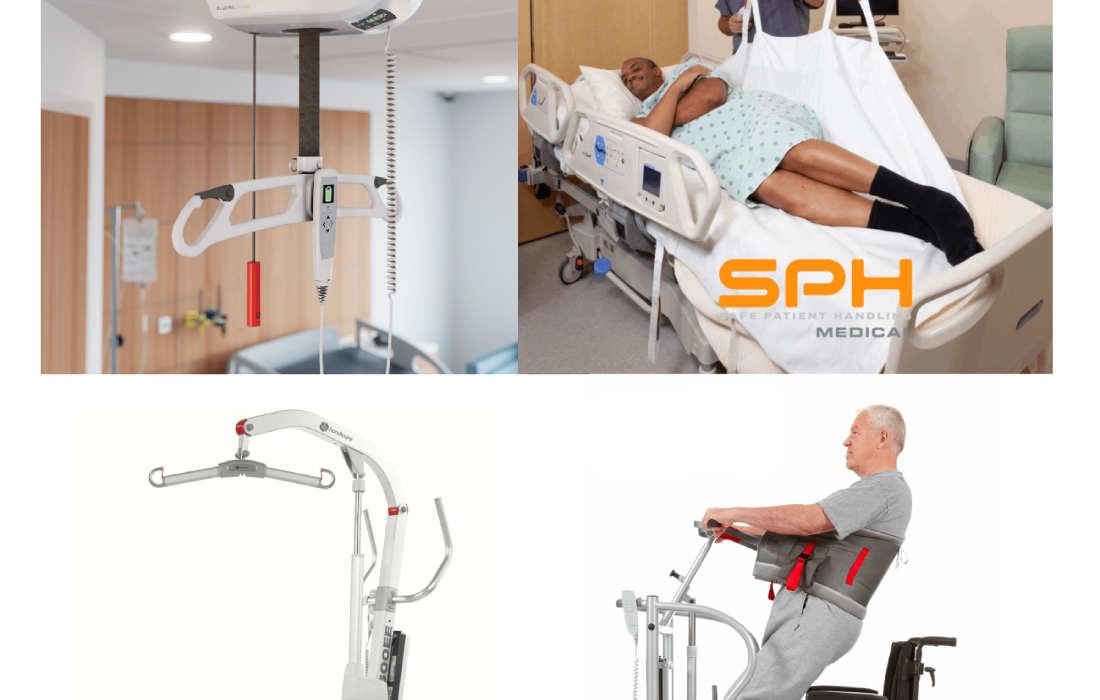
Mobile floor lifts are wheeled, portable mechanical lifts that raise, lower, and transfer patients using a sling, giving your units flexible lifting power exactly where it is needed.
A mobile lift rolls from room to room, so a single unit can serve multiple patients and multiple bays without permanent installation. Paired with the correct sling, it performs the vertical transfers that occur throughout the day. Its portability makes it ideal for units where fixed infrastructure is impractical or where lifting needs shift from one hour to the next.
Mobile floor lifts address a clear set of high risk tasks:
• Bed to chair and chair to bed transfers
• Chair to toilet and toilet to chair transfers
• Lifting a fallen patient safely up from the floor
• Sit to stand transfers with the appropriate lift and sling
Consider a Med Surg unit that shares two mobile lifts across a corridor. Staff move each lift to the room where the next dependent transfer is scheduled, extending safe lifting power across the entire floor. Mobile lifts deliver adaptable, whole unit lifting power, which makes them a versatile foundation for any SPHM program. For the tasks nurses perform most often, a second lift type offers distinct advantages.
How Overhead Ceiling Lifts Work — and Why Track Design Matters
Overhead ceiling lifts suspend the patient in a sling from a track mounted overhead, allowing safe transfers and repositioning with minimal effort and no floor space required. They are highly effective — but not all ceiling lift motors and track systems are equal, and choosing the right design for each clinical setting is one of the most important decisions a facility can make.
The traverse system, also called an X-Y gantry, is installed in most ICUs, Med Surg, and Rehab areas because it offers the greatest room coverage and moves effortlessly in any direction. Repositioning patients in bed, bedside ambulation, and even picking a patient up from the floor are all easily accomplished with a traverse system in place. For high acuity rooms where care demands are unpredictable, this flexibility is essential.
Straight track designs serve a different purpose. They are a strong choice wherever the transfer location is fixed and predictable, such as moving a patient on and off a CT or X-ray table. When the path of travel never changes, a straight track delivers reliable, efficient performance without the added complexity of a gantry system.
Regardless of track design, ceiling lifts share one defining advantage: the motor stays in the room, ready the moment it is needed. Ceiling lifts require minimal caregiver effort for vertical transfers, and research confirms they are well accepted by nursing staff. Because the lift is always available at the point of care, it is ideal for high frequency tasks like repositioning and boosting a patient in bed, a task performed dozens of times per shift and a leading source of cumulative back injury.
That said, not all ceiling lift motors and track systems are equal, and matching the right system to the right setting is critical. The traverse system, also called an X-Y gantry, is the most versatile design and is installed in most ICU, Med Surg, and Rehab areas for good reason. It covers the entire room and moves effortlessly in any direction, so repositioning patients in bed, bedside ambulation, and even picking a patient up from the floor are all easily accomplished without repositioning the track or the patient. For high acuity environments where care demands shift constantly, that freedom of movement is essential. Straight track systems serve a different need. They are an excellent choice wherever the transfer location is fixed and predictable, such as moving patients safely on and off a CT or X-ray table, where a consistent path of travel is all that is required.
Here is how the two lift types compare at a glance:

Choosing the right ceiling lift for each clinical setting is just as important as choosing to install one. A traverse system, also called an X-Y gantry, provides broad coverage across the entire room, moving effortlessly in any direction. This makes it the preferred choice for ICU, Med Surg, and Rehab areas where repositioning in bed, bedside ambulation, and picking a patient up from the floor are all part of daily care. A straight track system suits a different need, excelling where the transfer path is fixed and predictable, such as moving patients safely on and off a CT or X-ray table. Matching the system to the task ensures every ceiling lift investment delivers its full clinical value. In an ICU room with a traverse system, one nurse can reposition an equipment dependent patient up in bed on schedule, without waiting to locate and roll in a floor lift. Overhead lifts shine in several settings:
• Repositioning and boosting patients in bed
• Frequent vertical transfers in high acuity rooms
• Confined spaces where a floor lift cannot maneuver
• Immediate availability at the point of care
Overhead lifts remove the friction of retrieval and setup, making them the strongest choice for the most repeated high risk tasks. Neither lift type alone covers every need, which is why the two work best together.
How the Two Lift Types Complement Each Other
A truly comprehensive safe patient handling program pairs mobile and overhead lifts so that every high risk task, in every setting, has a safe mechanical solution.
Overhead lifts deliver always ready coverage in designated rooms, while mobile lifts extend lifting power to areas without installed track. The SPHM evidence is clear that no single device solves every task across a facility, so matching the right lift to each task is essential. Together, the two eliminate the availability gaps that push nurses back toward manual lifting under time pressure.
The pairing delivers full coverage:
• Fixed, immediate lifting in high acuity and high frequency rooms
• Portable lifting for shared, overflow, and unequipped spaces
• A safe option for both scheduled and unplanned transfers
• Alignment with ANA and AORN standards across the continuum of care
Think of a value analysis committee that equips ICU rooms with ceiling lifts for constant repositioning, then deploys mobile lifts across Med Surg to cover transfers where installed track is not feasible. The two lift types are not competing choices. They are partners that, together, close the coverage gaps a safe program cannot afford. That complete coverage translates directly into measurable safety and financial gains.
Staff Safety, Workers’ Compensation, and ROI Gains
Mechanical lift equipment protects the workforce while reducing avoidable costs, delivering returns that speak to both the safety officer and the finance office.
Removing manual lifting reduces the strains, sprains, and back injuries that drive lost workdays and workers compensation claims. Because back injuries account for 33 percent of workers compensation costs, reducing them produces significant, measurable savings. Safer handling also protects experienced staff from career ending injury and supports patient safety, dignity, and satisfaction during every transfer.
The return on investment shows up in clear places:
• Reduced workers compensation claims and injury severity
• Fewer lost workdays and lower replacement staffing costs
• Improved staff retention and reduced turnover
• Higher patient satisfaction and stronger process improvement outcomes
Imagine a committee comparing the one time cost of lift equipment against a single year of documented staff injury claims tied to manual handling. The return quickly becomes clear. Lift equipment is not an expense. It is a high return investment in safety, compliance, and cost containment that pays back year after year.
Build a Complete Lift Program
Manual lifting remains a leading injury risk in nursing, and mechanical lift equipment is the evidence based solution. Mobile lifts deliver portable, adaptable lifting power, while overhead lifts provide always ready coverage for high frequency tasks like repositioning. Together, they form the backbone of a comprehensive SPHM program where no high risk task is ever left to a nurse’s back.
Start by assessing where your units still rely on manual lifting. Identify the coverage gaps between your installed and portable equipment, then bring your findings to your SPHM or value analysis committee. A strong program relies on both lift types working together.
Ready to protect the people who care for everyone else? Contact SPH Medical for a quote or a consultation today.
Frequently Asked Questions
What is the difference between a mobile lift and an overhead lift? A mobile lift is a wheeled, portable device that rolls between rooms and requires no installation, making it ideal for varied transfers across a unit. An overhead lift is mounted to a track in the ceiling and stays permanently in the room, ready at the point of care. Mobile lifts offer flexibility, while overhead lifts offer always ready availability for frequent tasks.
**Which ceiling lift design is best for repositioning patients in bed?** An overhead ceiling lift with a traverse, or X-Y gantry, system is the strongest choice for repositioning and boosting patients in bed. The traverse system covers the entire room and moves effortlessly in any direction, making it ideal for ICU, Med Surg, and Rehab areas where repositioning in bed, bedside ambulation, and picking a patient up from the floor are all part of daily care. Straight track systems serve a different need, excelling where the transfer path is fixed and predictable, such as moving patients safely on and off a CT or X-ray table. Matching the track design to the clinical setting ensures every ceiling lift delivers its full value.
Do mobile and overhead lifts align with ANA and AORN SPHM standards? Yes. Both the ANA and AORN call for eliminating manual patient lifting wherever feasible, and mechanical lift equipment is one of the few interventions with strong evidence for reducing caregiver injury. Deploying both lift types demonstrates due diligence in protecting staff and supports compliance across the continuum of care.
How do I get a quote for mobile or overhead lifts? Contact SPH Medical directly to request a quote or schedule a consultation. The team can help you assess your current coverage gaps and match the right combination of mobile and overhead lifts to your units and patient population.